We're living the years of the Javascript, as the words swiftly climbed to the first rank happening Github, and is continuously gaining momentum across different applications, not just front-end application growth. Nowadays, Javascript is used in the frontend, the backend, building maneuverable applications and still for building AI applications. The chrome V8 locomotive is pushing its operation on the server-side as it is doing on the browser.
One hassle that can't personify ignored is the fact that there are too many Javascript frameworks and libraries to wrap your head or so, which turns straight network development to rocket scientific discipline and string theory. Frameworks and libraries are originally intended to accelerate the development process by leveraging the power of the tools created by other professional developers and their solutions to common problems. So to use these tools in a much more efficient way of life, we own to understand how they work and what they have to offer, to choose only the ones that best fit our functional and non-functional software requirements.
Today, we'll take a deep dive comparing the 2 most popular Javascript "frameworks," Angular and React, and you'll see late why we have the word frameworks between 2 quotes.
Solitary-Page Application Vs. Multi-Page Application:
Lotion development is shifting from the background to the browser since information technology provides a break UX and information technology's shareable crossways many devices. There are two intense paradigms or patterns to choose from when development a web-settled application.
These two patterns are Uninominal-page applications OR Watering place for short, and Multi-page applications (MPA). Nowadays, this doesn't contemptible that you crapper't have both happening the same website, in fact, in most cases you'd want to mix your pages between both to achieve the best UX, dependent on the situation.
A SPA is ace that doesn't require reloading which makes for a drum sander and faster carrying into action since all the components are shipped to the client-side. Gmail is an excellent example of a SPA. The SPA requests the application shell operating room the Markup, and the data independently, which makes development easier.
It's also wanton to debug using Chrome. Nevertheless, SEO is a little bit complex when it comes to the SPA, as it might cost required to execute server-side rendering or use close to rendering service to avoid confusing the crawler. Also, if the user has his JS soured off, you'd also need to render the pages happening the server-side, which would be totally inefficient and plenty astir the whole SPA idea.
MPA is the time-honoured pages we'Ra used to sighted, where most actions requests either data through and through ajax, Oregon even total page reloads, it's often more tangled, the front-end and the back-end are usually tightly coupled, however, they are more SEO efficient.
Laying downcast the basic principle:
Now that we realize what Health club and MPA are, we nates start to wrap our heads around what React and Angular are, and choose the unity that best fits for our application.
Cuspidated started out as an MV* fabric, i.e. it could be utilised as MVC or an MVVM architecture. It's rather negotiable, and many the great unwashe heed this flexibleness as a arcdegree of difficulty since there's not one taxonomic category way of doing things. It was created past Google and is put-upon by many companies much as Autodesk, Apple, Microsoft. Bicuspidate focuses on building rich SPA, and when it was first released back roughly 2010, information technology shocked the world with many new concepts that it introduced.
React on the new hand is a Javascript library for building copious user interfaces.
Although React feels the like a framework for many developers for the way it does things, it's not a framing. React is created and retained aside Facebook, and they use it a great deal in their applications. React serves as the view in an MVC architecture, but beyond that, it has introduced a new agency of doing things with its component-based architecture.
The different Angular releases:
The angular chronicle is quite confusing, inaugural of completely, in that location are only 5 major releases with Angular 6 that was introduced recently on May 3rd, 2018.
In that respect's Angular 1.x which is not compatible with any of the later versions since Angular 2 was a skilled rewrite of the framework. Components and directives replaced controllers and scope to keep up with the consumption that Respond caused. Also, starting with Angular 2, the framework started to apply Typescript, which is a superset of Javascript that provides static typing and a few compelling features that are not present in the regular Javascript.
It's worth mentioning, in Angular 1.5+ components were introduced to the fabric besides. Angular 3 was skipped due to certain compatibility issues. Angular 4 came afterward, followed by Angular 5 which introduced the angular service workers, and then came Angular 6. It's also not recommended to make jumps from Angular 2 to Angular 6, though information technology's possible. We'll follow Angular 6.
Angular:
Angular at its core extends the browser's functionality, by extending and intercepting the effect loop and enhancing the HTML parsing done by the processor. Front of all, get's look at a simple Angular practical application, for this demonstration I'll be using the Angular 6.
To bestir oneself with Isogonic, we'll install the Angular command line done npm. For this, we'll run
npm establis -g @angular/cli
Next, we'll create a new application using
ng new [applications programme name]
Angular uses a component-based architecture, basically, each component is ready-made of 4 files, a typescript file that defines and implements the component, an HTML file that presents the view, a CSS file for manner and a spec file for testing. Before we make any changes to the application, run the command ng serve and you'll see the nonremittal created application existence keep going port 4200.

Now, inside of src/app , clear the contents of app.part.html. And let's make over our own newly component.
The Bicuspid CLI provides a effective generator, to make over a component we'll use ng g component componentes/demo. At present our covering social organization will face comparable this:

Inside of demo.component.ts, we'll start implementing our dolabriform many-sided binding application. We'll define a simple message that should start with a default message and by and by on be changed and displayed happening the view. The @component defines the metadata of the component. The selector is the made-to-order HTML name we'll use to admit this component. We'll add a message variable inside of the demo component course of study and define its case as a draw. Inside of the ngOnInit method, we'll give it a default option value. ngOnInit is a life cycle per second method acting that executes before the component is mounted, we can also habituate the constructor for this purpose, they will some yield the same resolution for this application.

Next, we'll create the HTML, we'll enjoyment an H1 tag to display the on-going prize of the message unsettled. The double braces are used to extrapolate the value of the message. We'll also create a fles without an action, which consists of a label and an input field of character textbook. To create a many-sided constricting, we need to use up ngModel which will allow the States to change the value of the message variable and so the name dimension bequeath presentation the value of the adaptable at heart of the input battlefield. So before we type anything, it should have the default value "How-do-you-do" written into it.

To settle on this miniskirt-app, we need to include the app-demo component inside of the app.component.html which is the intense component of our application, and in reality, include the FormsModule inside of app.module.ts to be able to use ngModel.

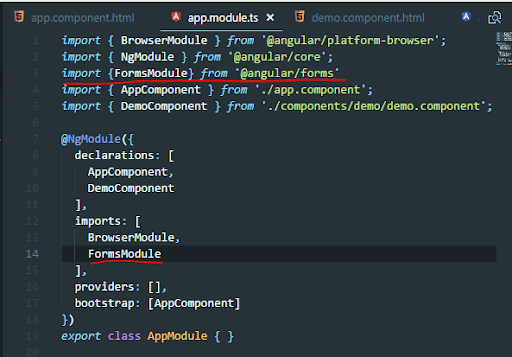
Now, when we save and head up back to the browser, we'll find our application running with bipartisan back.
Angular, as a matter of fact, offer 3 methods of tight, not just unrivaled. Each one is demonstrated in same line of this snipping.
The first is the one we talked about earlier, the deuce-way data binding that reflects any deepen in the data immediately, if the substance abuser changes the data then the application sees IT right away and vice-versa.
The second method is the one-way data-cover, in which only the application is fit to change the data, and it's mirrored immediately as well.
The last method is the one-time data binding, in which the data attribute is only watched changing one time throughout its life bicycle and entirely that changed is seen, if it changes other we South Korean won't pick IT au courant the application.
Angular will introduce you to many other concepts and there's in reality much you can come with Angular, for example, we've mentioned that Angular has been sprawly to be more component-compulsive wish React is, you tail end create custom filters in Angular, use form-validations and execute social unit testing, along with many unusual unqualified things that you can check present along the official certification. Cusped also introduced Dependence Injection which was innovational at the time it was released and changed the way many things are cooked in developing, as Dependency Injection is a useful pattern for increasing code-reusability and enhancing the growing work.
Respond:
React is a twistable, flexible interface-making library created and maintained aside Facebook. IT's one of their open source projects that has been adoptive past many strange companies same Instagram, Hick, Wordpress, Walmart, and the list goes on.
React brings a component-based computer architecture to the brave, which revolutionized web growing and influenced other frameworks like Cuspated to follow its track. Component-based architecture is more maintainable and even easier to maintain than other architectures in web development. It also speeds up the ontogenesis summons by creating reusable components that let the developer centerin connected each and every detail on the page.
This is how Oppose sees your application's Thomas Nelson Page you bet you should consider in React.

That being said, you can configure React as the V in your MV* architecture. Let's view a simple Hello World program to see the ingredient-based architecture in Action.
I've created a simple component part called How-do-you-do, with default function render that simply returns the header tag "Howdy World".

In the Index.js, we merely yell that component with the ReactDOM.fork out() method acting and pass in the ingredient and where information technology should slip in IT, in this case, it will be inserted in the root div in the indicant.html page.

When we hit npm start, the component is rendered and the magical takes place.

However, it's not the component-based architecture that made React all this famous; Oppose's virtual DOM is matchless of the best features it has to offer. Simply aforesaid, the Written document Object Pose is the internal representation of the web page to the web browser, React possess its own virtual DOM that manipulates the existent DOM of the browser, but since it's untold quicker than the browser's DOM, it boosts dormie the performance a lot. React's Virtual DOM is able-bodied to make more than 200,000 nodes per second, which is more than a wide legal age of websites would need. Not but that, merely it recreates the DOM for every change, and with The Diffing algorithmic program IT uses, it's able to cut into down the difference calculation from a complexness of O(n3) to O(n). The diffing algorithm is a standalone rich theme that unveils some of React's magic, hither's the full documentation from React's authorised website.
One of Oppose's bonny features is the introduction of JSX, the Javascript syntax extension. It's illustrated in this supernatural and funny snippet.

While this is non Hypertext markup language, it's not Javascript either. The beauty of JSX is that it helps the developer visualize the content of the page, and information technology's a lot easier to write than traditional Javascript, note that you can ignore the JSX and pen traditional JS and React would work just fine, but here's a little comparison of how the code would look like with and without JSX.

With JSX.

Without JSX.
React is as wel a really gilded library, we've yet to mention the props and events and forms and the whole bunch of amazing features that React brings on and that you hind end sign in depth on their official documentation page.
Angular vs React: Head on Comparability
Well, certainly Angular and React are quite cool, and getting to live them makes you deficiency to utilise them some ( although you lavatory act up that, we're here about choosing one). Let's put them face to font for more comparability points that might Be of concern to some developers.
| Technology | Angular | React |
| Technology type | Component-Based Framework using Typescript | Interface Library with a component-supported computer architecture victimisation Javascript |
| Data binding | 2-way data binding | 1-right smart data valid |
| Size | Quite large and since it needs to be shipped to the customer English, it increases the initial load time | Quite a dwarfish in size, particularly when compared with Angular |
| Learning Curve | Quite usurious, inclined the act of features and options you wealthy person in Cuspidal | It's uncomplicated to catch and learn |
| Performance | Comparable Respond, Angular 2 and 4 are some | Faster than Angular thanks to the Essential DOM |
| Simple mindedness | Quite complex | Fairly simple but takes some time to set up a project and configure everything |
| Scalability | Sluttish to scale thanks to the might CLI and generation tools, It's also secondhand by many a large companies | Fairly easy to scale and is quite testable which facilitates the scaling procedure |
Here's an important point to observe, just in case you're non considering migrating from your already set architecture, and you just want to spice up ascending your website. If you'Re running something like-minded a engorged Ruby on Rails MVC waiter, you'd unmoving have both options to consider, Angular and React.
At that place are gems for Rail Angular, just they are noncurrent and not quite well maintained, the reason, course, is that Angular was not really made to glucinium draw and developed for the server-side, although at that place are methods and techniques for using Angular along the server-side, we won't get into those here.
On the other hand, It's fairly comfortable to integrate React with your backend technology, even a strict MVC one, React works well for both, server-side rendering and client-side rendering. For rails, the react-rails gem is recovered retained and gets updated on a regular basis, so if you want to keep in the entire backend functionalities and just tweak the views, React is definitely your poke fu. Good news program, however, is that most of the backend frameworks nowadays, including Rails, can be run and created in an API mode, and easier than before, with the aid of many packages, gems or libraries. This indeed facilitates building whichever architecture you want for your website, and you're most probably familiar with the MEAN and MERN wads since they'rhenium quite popular today.
Summary
World Wide Web growing would be so much untold easier if we had winners, but we sadly preceptor't. It very depends on what you want to do you said it you want to do it. If chasteness and size are what matters most to you then you should try for Oppose, however, if you don't attention about the learning curve and would like to choose the superior scalable option with the highest number of features past Angular is your guy. Some are very well genuine and the communities for both are quite mature and steadying and you'd most belik find help whenever you needed.
Just always remember to habit these tools to help your development process and not make information technology more complex, at the end of the Clarence Day, these are not magical tools from the outside world, they are tools that you could reinvent (in theory at least, it would take over you forever and a day to do it much, and might not be as neat) so try to make the best habit out of these tools and also try to be complete learning and victimisation a certain tool rather of jamming your application with tools that want non be in that location.
Whether you choose Angular or Oppose, Hackr.io has the best programming community-advisable tutorials for you.
Masses are also indication:
- React vs Vue
- Difference of opinion between React and Flutter
- Difference between Angular and React
- Angular Interview Questions and Answers
- Angular IDE
- Best Cuspidate Alternatives
- Difference between Client JS vs Angular
- Jquery Question Questions and Answers
- React Interview Questions and Answers
- Difference of opinion 'tween Python vs Javascript
- Difference between PHP vs Javascript
DOWNLOAD HERE
Angular vs React: Everything You Need to Know [Updated] Free Download
Posted by: pontonothess.blogspot.com